
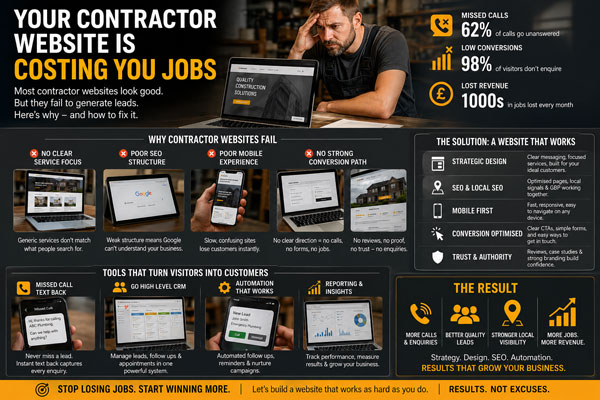
Your Contractor Website Is Costing You Jobs | How to Fix It
Most contractors think their website is working.
It looks clean. It has services listed. There is a contact form. Maybe even a few photos of past jobs.
But despite all of that, the phone is not ringing as much as it should. Enquiries are inconsistent. Some weeks are busy, others are quiet. And it is not always clear why.
The uncomfortable truth is this. A contractor website can look good and still quietly lose jobs every single day.
The problem most contractors do not see
The issue is rarely just traffic.
Many contractors are getting visitors from Google. Some are even running Google Ads or Facebook Ads. Others are showing up on Google Business Profile listings.
But visitors alone do not create revenue.
If your contractor website design is not built to convert, every click becomes a missed opportunity. Someone lands on your page, looks around for a few seconds, and leaves. They then search again and contact a competitor who made it easier to take the next step.
That is how jobs are lost without you ever knowing they existed.
Why your contractor website is not getting leads
There are a few common patterns that show up again and again across contractor websites in the UK.
The first is lack of clarity.
A potential customer lands on your site and cannot immediately tell:
What exact service you offer
Where you operate
Why they should trust you
What they should do next
This confusion kills conversion.
The second issue is weak positioning.
Most contractor websites say the same thing. Reliable service. Professional team. Competitive pricing. Those phrases do not separate you from anyone else.
Without clear differentiation, customers default to whoever is easiest to contact or appears more visible on Google.
The third issue is missing trust signals.
Reviews, project examples, location relevance, and Google Business Profile consistency all play a role in whether someone feels comfortable contacting you.
If your online presence feels incomplete, customers hesitate. And hesitation leads to lost enquiries.
The cost of a website that does not convert
This is where the real problem starts to matter.
A non converting website does not just sit there doing nothing. It actively costs you jobs.
Every visitor who leaves without contacting you is:
A missed quote
A lost opportunity
Revenue that goes to someone else
If your website conversion rate is low, even a small increase in performance can change everything.
For example, if 100 people visit your site and only 2 contact you, improving that to 5 enquiries can more than double your opportunities without increasing traffic.
This is why contractor lead generation is not just about getting more visitors. It is about making the most of the visitors you already have.
Why contractor SEO alone is not enough
Many contractors invest in SEO expecting it to fix everything.
SEO can improve visibility. It can help you rank for terms like contractor SEO UK or local SEO for contractors. It can bring more traffic from Google.
But traffic without conversion is wasted.
If your pages are not structured properly, if your messaging is unclear, or if your site is not aligned with search intent, SEO will only send more people into a system that does not work.
That is why SEO and website conversion must work together.
The role of local SEO in contractor websites
Local SEO is one of the biggest drivers of high quality leads.
When someone searches for services in their area, they are often ready to take action. They are not browsing. They are looking for someone to hire.
If your website and your Google Business Profile are not aligned, you lose that advantage.
Local SEO for contractors depends on:
Clear service pages
Location based content
Consistent business information
Reviews and recent activity
Strong relevance to the search query
Without this structure, Google has less reason to show your business. And even when it does, customers may not choose you.
Why AI SEO is becoming important
Search behaviour is changing.
More people are now using AI tools to research businesses before making decisions. Platforms like ChatGPT, Google AI results, and other AI driven search tools are shaping how customers evaluate options.
This means your website is no longer the only place where decisions are made.
AI SEO focuses on making your business understandable and trustworthy across these systems. It includes:
Clear, structured content
Consistent information across platforms
Strong entity signals
Accurate business data
If AI tools cannot confidently understand or recommend your business, you lose visibility before a customer even reaches your site.
How automation platforms like Go High Level fit in
Even when a website generates enquiries, the process does not stop there.
Response speed, follow up, and lead handling all impact whether that enquiry becomes a job.
This is where tools like Go High Level come into play.
Go High Level CRM for contractors allows businesses to:
Capture leads from forms, calls, and ads
Automate follow up messages
Manage conversations in one place
Track where leads come from
When combined with a strong website, this creates a complete lead generation system instead of isolated tools.
Without this structure, even good leads can slip through the cracks.
The gap between traffic and revenue
The biggest misunderstanding in contractor marketing is the belief that more traffic automatically means more jobs.
In reality, there is a gap between those two points.
Traffic is attention. Revenue is conversion.
Everything in between determines whether a visitor becomes a customer.
That includes:
Website design
Messaging
Trust signals
Local relevance
Speed of response
Follow up systems
If any of these elements are weak, performance drops.
What a high performing contractor website does differently
A website that generates consistent leads behaves very differently.
It answers key questions immediately.
It shows the visitor they are in the right place. It makes the next step obvious. It removes friction.
It also aligns with how people search.
Instead of generic pages, it uses targeted service and location content. It supports local SEO. It reinforces credibility through reviews and real examples.
And it connects into a wider system that captures and follows up with leads.
This is what turns a website into a working part of the business rather than just an online brochure.
Why most contractor websites stay the same
Despite these issues, many websites are left unchanged for years.
Part of this comes from not knowing what is wrong. If a site looks acceptable, it is easy to assume the problem lies elsewhere.
Another factor is focus.
Contractors are busy running their business. Jobs, teams, and operations take priority. Marketing often becomes reactive instead of structured.
This is why the same problems persist.
Websites remain static while search behaviour, competition, and customer expectations continue to evolve.
The shift towards systems, not just websites
The businesses that see consistent growth online tend to approach this differently.
They do not rely on one channel.
Instead, they build systems.
A website is supported by SEO. SEO is supported by local signals. Local presence is supported by reviews. Leads are supported by automation and follow up.
Everything works together.
This is the difference between occasional enquiries and predictable lead flow.
Where most of the opportunity sits
For many contractors in the UK, the opportunity is not in doing something completely new.
It is in fixing what is already there.
Improving website conversion. Strengthening local SEO. Aligning messaging. Adding structure to lead handling.
These changes often have a greater impact than simply increasing ad spend or chasing more traffic.
Because they address the core issue.
Not visibility alone, but performance.
This is why a contractor website is not just a design decision.
It is a business decision.
And when it is not working properly, it does not just sit quietly in the background.
It costs jobs.