
Lead Generation for Contractors: The 2026 Playbook for Building a Pipeline You Own
Summary
•The best lead generation strategy for contractors isn't a single channel — it's a stack of owned assets (Google Business Profile, your own website, and Local Services Ads) layered with paid ads and referrals.
•Shared-lead platforms like Angi and HomeAdvisor sell the same lead to 3–8 contractors, which destroys margins and gives you no ownership of the customer. The FTC ordered HomeAdvisor to pay up to $7.2M in 2023 for deceptive lead-selling practices.
•The average cost per lead for construction and contracting via Google Ads in 2025 was $165.67, and $228.15 for roofing — but the cost per acquired customer is what matters.
•Contractors who respond to inbound leads within 5 minutes are 100× more likely to make contact and 21× more likely to qualify (MIT Lead Response Management Study). 78% of customers buy from the first business that responds.
•The contractors who win in 2026 own three things: a high-converting Google Business Profile, a fast website built to convert, and a response process that beats their competition by minutes.
•AI search engines (Google AI Overviews, ChatGPT, Perplexity) are increasingly intercepting “best contractor near me” queries. The contractors cited in those answers are the ones with the deepest structured content.
Why “the best way” is the wrong question
If you type “best way to generate leads for contractors” into Google right now, you'll get fifteen open tabs of nearly identical listicles. “21 proven methods.” “15 lead sources.” “11 tactics every contractor should try.” They're not wrong, exactly — they're just shallow.
The reason most contractor marketing advice is shallow is that it's written for breadth, not depth. The reality on a job site is the opposite. You don't need 21 tactics. You need three or four channels that compound, a clear order of operations, and a way to know which ones are working.
Lead generation for contractors in 2026 looks fundamentally different than it did even three years ago. The platforms that dominated discovery (Angi, HomeAdvisor, Thumbtack) are bleeding contractor trust and racking up government settlements. Google's own ad inventory has fragmented into a stack with Local Services Ads, the map pack, sponsored listings, and now AI Overviews that increasingly answer questions before users click anything. Meanwhile, the underlying market has tightened — the Joint Center for Housing Studies at Harvard reports that home sales in 2025 hit a 30-year low as affordability pressures squeezed buyers.
That tightening cuts two ways. There's less ambient demand floating around, so contractors who win discovery win disproportionately. And the National Association of Home Builders projects the industry needs roughly 740,000 additional workers per year just to keep pace — meaning the contractors with steady inbound work get to be choosier about which jobs to take.
This guide is the one I'd give a contractor friend who asked, “Where do I actually start?” It's not a list of 21 tactics. It's a channel-by-channel breakdown of what generates leads for contractors in 2026, what doesn't, and how to decide what to build first.
The contractor lead-gen landscape in 2026
A few realities shape every decision below.
First, discovery has consolidated around Google. When someone needs a contractor, the search journey almost always begins on Google — even if it ends elsewhere. That means Google Business Profile, Google Maps, Google Ads, and Local Services Ads are not optional. They are the playing field.
Second, trust has fragmented. Customers used to trust the Yellow Pages, then they trusted Angi, and now they trust Google reviews, neighborhood-level word of mouth (via Nextdoor and local Facebook groups), and increasingly, AI-generated summaries. The contractors who appear credible across multiple surfaces win the click; the ones with thin profiles get skipped.
Third, the unit economics have shifted. The LocaliQ 2025 Home Services Search Ad Benchmarks report puts the average cost per lead across home services at $90.92. For “Construction & Contractors,” it's $165.67. For “Roofing & Gutters,” it's $228.15. Those numbers have crept up year over year and will keep doing so. That makes owned channels — the ones you don't have to keep paying to use — disproportionately valuable.
Fourth, shared-lead platforms are in active decline. The FTC settlement against HomeAdvisor, the Vermont AG action, the BBB complaint volume, and the steady drumbeat of forum and Reddit posts calling these platforms scams have shifted contractor sentiment. The platforms aren't gone, but their share of contractor lead spend is dropping for the first time in a decade.
This is the backdrop. Now the channels.
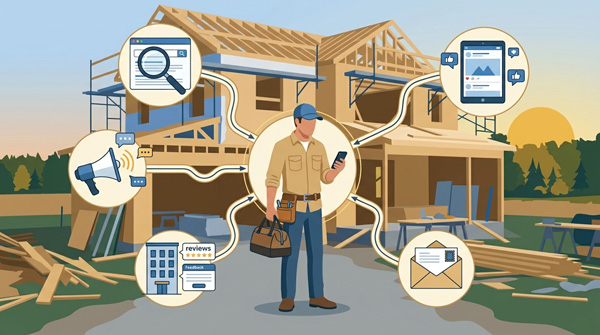
The five channels that actually generate contractor leads
1. Google Business Profile and local SEO — the free moat
Your Google Business Profile (GBP, formerly Google My Business) is the single highest-ROI marketing asset a contractor can build, full stop. When someone in your service area searches “general contractor near me” or “bathroom remodel [your city],” Google shows the map pack — three local businesses with reviews, photos, and a map — above almost everything else.
Ranking in the map pack is driven by three big factors:
Relevance — Are your primary and secondary categories set correctly? (Tip: your primary category is the single most important field on your profile. “General Contractor” ranks differently than “Construction Company” or “Home Builder.” Pick the one your customers actually search for.)
Distance — How close are you to the searcher?
Prominence — How established is your business? Reviews, citations across the web, photos, and posting frequency all feed this.
Most contractor GBPs are 30% filled out. They have a phone number, address, and maybe ten reviews from 2021. That's a layup left on the table. Filling out every field, adding 50+ real project photos, posting weekly, and getting reviews into the triple digits will out-rank a competitor with a bigger ad budget but a half-baked profile.
Wildlangosta service callout: This is exactly what GMB Optimisation for Contractors handles — full profile build-out, category research, review acquisition, and weekly posting.
2. Your own website — the asset Angi can't take away
Your website is the only lead source you fully own. Angi can shut your profile down. Google can change its algorithm tomorrow. The website on a domain you control is yours forever.
To make it actually generate leads, three things have to be true.
It has to be fast. Mobile page-load speed under three seconds. Anything slower bleeds 20–40% of traffic before it even sees your homepage.
It has to convert. Phone number in the top-right corner, tap-to-call enabled. Real project photos (not stock). Quote form above the fold on every service page. Trust signals near the form — licenses, insurance, BBB rating, Google review count.
It has to capture intent. Service pages targeting the exact phrases your customers type. Kitchen remodel [city]. Roof replacement [city]. Bathroom contractor [city]. Each page should answer the buyer's full set of questions: scope, typical price range, timeline, what's included, before/after photos, and a clear next step.
This last point matters more in 2026 than it has in any previous year, because AI search engines like Google's AI Overviews, ChatGPT, and Perplexity are increasingly answering buyer questions before the user clicks anything. The contractors whose service pages are deep, structured, and locally specific are the ones being cited in those AI answers. Thin pages get skipped.
Wildlangosta service callout: Websites Built for Contractors — purpose-built sites that load fast, convert, and feed the AI search systems that increasingly mediate discovery.
The other half of the website equation is response speed. The most-cited piece of research on inbound lead conversion remains Dr. James Oldroyd's MIT Lead Response Management Study, which analyzed over 15,000 inbound leads. The findings were brutal: businesses that responded within 5 minutes were 100× more likely to make contact than those that waited 30 minutes, and 21× more likely to qualify that lead. The Harvard Business Review later cited the data in “The Short Life of Online Sales Leads,” and a follow-up finding became the line every sales coach quotes: 78% of customers buy from the first business that responds.
The average business takes 47 hours to respond to an inbound lead. The average contractor isn't far off. Closing that gap — with text notifications, a virtual receptionist, or a phone tree that actually picks up — is the cheapest lever in this entire playbook.
3. Google Local Services Ads — the credibility play
Local Services Ads (LSA) sit above the map pack and above the regular search ads. They display your business name, review count, hours, and — crucially — the Google Guaranteed badge that signals Google has verified your license, insurance, and background check.
Three things make LSA the strongest paid channel for most contractors:
You pay per lead, not per click. This single change in pricing model flips the economics. A click that doesn't convert is wasted money on Google Ads. A “lead” on LSA is someone who has explicitly contacted you.
Lead exclusivity is higher than shared platforms. LSA leads aren't sold to 8 competitors the way Angi leads are. The contractor who answers first generally gets the job.
The Google Guaranteed badge converts. Customers are wary of contractor scams. A Google-verified license-and-insurance badge does more for trust than any award logo on your homepage.
The catch is that LSA approval takes time — license verification, insurance verification, and a background check on the business owner — so it's worth applying early even if you're not ready to spend immediately. Once approved, you can throttle the budget up and down.
4. Google Ads and PPC — the speed play
Google Ads (search) and PPC complement, rather than replace, the channels above. Their unique value is speed. SEO and GBP optimization compound over months. A well-built Google Ads campaign can produce qualified phone calls within 24 hours.
The economics in 2026 are unforgiving. The LocaliQ 2025 Home Services Search Ad Benchmarks report puts the average cost per click for home services at $7.85, with construction-segment costs per lead landing at $165.67 on average and roofing at $228.15. Margins survive that math only if you do three things:
Match-type discipline. Use phrase and exact match. Broad match in this category will drain a budget on irrelevant searches faster than any other vertical.
A real negative-keyword list. “DIY,” “how to,” “salary,” “school,” and dozens of trade-specific exclusions need to be in place from day one.
Tight geo-targeting. Service areas, not metro-wide. If you only drive to homes within 30 miles, your ad shouldn't show up 50 miles away.
Wildlangosta service callout: This is the discipline behind Paid Lead Generation for Contractors — campaigns built for the contractor unit economics, not generic e-commerce templates.
5. Past-customer reactivation and referrals — the cheap-and-loyal channel
The cheapest qualified lead any contractor will ever get is from a customer they've already served. Referral leads typically close 2–3× faster than cold inbound, and at almost zero cost.
The mistake most contractors make is treating referrals as passive. They aren't. They're a process.
At project completion: Ask for the review on the spot. Send the Google review link via text (texted links convert about 2× better than emailed). Ask if the customer knows anyone in the neighborhood who's planning work.
At 90 days: Check-in text or email. “Everything still holding up? Anything we should look at?”
Seasonally: For HVAC, plumbing, and roofing especially, a tune-up offer to past customers is the single highest-ROI marketing email a contractor can send.
On-site marketing: A professional yard sign at every job — with a phone number and QR code — is the most under-used local lead source in residential construction. Door hangers in the surrounding block while the truck is parked outside cost almost nothing and produce neighborhood-level inbound that no platform can match.
![A neighborhood street view with a "Project by [Contractor]" yard sign in a front yard](https://assets.cdn.filesafe.space/Fmwzmc1xIRgvNtKxP4FD/media/6a16ea9d5be84ad64004ea56.jpg "A neighborhood street view with a \"Project by [Contractor]\" yard sign in a front yard")
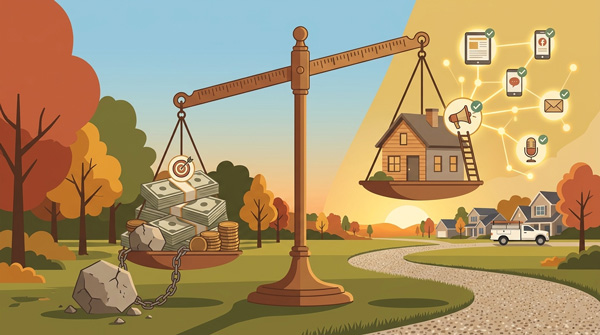
Why Angi, HomeAdvisor, and shared-lead platforms aren't the best way
This is the section most contractor marketing articles avoid, because the shared-lead platforms spend heavily on the industry's media. Wildlangosta has no such conflict, so here's the unvarnished version.
The shared-lead math doesn't work. Angi and HomeAdvisor (which merged in 2017 and now operate under the Angi umbrella) sell each lead to 3 to 8 contractors simultaneously. You don't compete on quality of service — you compete on who answers the phone first. A typical Angi Pro subscription runs around $400 per month, plus $30–$100 per lead depending on the category. Roofing leads can hit $150–$300 a piece. At a realistic 10% close rate, the platform's economics push contractor customer-acquisition costs well past $5,000 — for a lead the contractor doesn't own.
The platforms have been formally found to mislead contractors. In January 2023, the Federal Trade Commission ordered HomeAdvisor to pay up to $7.2 million for selling leads that “did not match the types of services contractors requested” and “did not match the geographic areas contractors had paid to receive.” The FTC's order details years of deceptive lead-sales practices. In 2025, the Vermont Attorney General added a $2 million settlement over similar conduct. The Better Business Bureau has logged more than 1,200 complaints against HomeAdvisor in recent years and downgraded its rating accordingly.
You don't own the customer. Even when an Angi or HomeAdvisor lead converts into a paying job, the customer relationship lives on the platform — not in your CRM. When that customer needs work again next year, they search Angi, not you. The lifetime value sits with the platform.
The platforms compete with you for your own customer's repeat business. Once a homeowner uses Angi to find you, Angi has their email and re-markets every related home-services category back to them — including ones you don't offer.
There is exactly one legitimate use case for shared-lead platforms: as a stopgap during a slow season for a contractor who has not yet built any owned channels. As a primary channel, the math doesn't work, the trust signal is fading, and the platforms themselves are under active regulatory and legal pressure.
Wildlangosta service callout: Lead Generation for Contractors builds the owned-channel stack that replaces shared-lead spend — typically at lower cost per acquired customer, with leads that compound rather than evaporate.
How to decide what to build first
If you tried to build all five channels at once, you'd dilute every one of them. The order matters.
The 90-day starter stack — for contractors who currently have nothing working:
•Month 1: Full GBP build-out, primary category research, photo upload, first 25 reviews requested.
•Month 2: Website rebuild or conversion-focused redesign. Service pages targeting your top 5 keywords. Lead form fast-routing setup.
•Month 3: LSA application and approval. Begin spending on the channel once verified.
By the end of 90 days, you have three owned, compounding channels working together and a measurable baseline to optimize against.
The 12-month compounding stack — for contractors with the basics in place:
•Months 4–6: Layer in Google Ads against the high-intent commercial keywords your GBP doesn't already capture. Continue review acquisition (target 100+ Google reviews by month 6).
•Months 7–9: Build service-area pages and case-study pages targeting the long-tail variants of your top keywords. This is what fuels AI search citation visibility in 2026.
•Months 10–12: Referral system formalization, past-customer reactivation cadence, neighborhood-level marketing (yard signs, door hangers) at every job.
Budget allocation for a typical residential contractor with average job value $15,000:
Channel: Google Ads
Monthly Spend: $1,500–$3,000
Percentage of Total: 40–50%
Channel: LSA
Monthly Spend:$1,000–$2,000
Percentage of Total: 25–35%
Channel: SEO / content / GBP ongoing
Monthly Spend: $1,000–$2,500
Percentage of Total: 20–30%
Channel:Tools, CRM, review software
Monthly Spend: $300–$600
Percentage of Total: 5–10%
The right total spend is roughly 5–10% of revenue for growth-stage contractors, 2–5% for established contractors with strong word-of-mouth.
Common mistakes that kill contractor lead generation
A handful of recurring mistakes destroy lead-gen ROI even when the channel mix is right.
Slow response. Five minutes or less, or you lose the lead. Period.
No proof on the website. Real photos, real reviews, real case studies. Stock imagery and vague testimonials do not convert.
Treating SEO as a one-off project. Local SEO is a maintenance discipline. The map-pack ranking you build can be lost in 90 days of neglect.
Buying leads instead of building assets. Every dollar spent on Angi is a dollar not invested in something that compounds.
Tracking nothing. If you can't answer “How did you hear about us?” for the last 50 leads, you're flying blind. Call tracking, source attribution in your CRM, and a one-question intake form solve this in a week.
Where to go from here
The best way to generate leads for contractors isn't a single tactic — it's a stack of owned channels, layered with paid spend that complements (not replaces) the assets you control, and a response process that beats your competition by minutes. The contractors who'll be busiest in 2026 are the ones who stopped renting leads from shared-lead platforms and started building the channels that compound.
If you want to see exactly which channels to build first for your specific trade, service area, and current footprint, request a free contractor lead generation audit from Wildlangosta. We'll show you what's leaking, what's working, and exactly what to build in the next 30, 90, and 365 days — whether you hire us or not.
FAQ
What's the cheapest way to get contractor leads?
The cheapest qualified leads come from past customers and their referrals — they cost almost nothing and close 2–3× faster than cold inbound. The next-cheapest sustainable channel is a fully optimized Google Business Profile, which is free to build and free to maintain. Local Services Ads typically beat Angi or HomeAdvisor on cost-per-acquired-customer because the leads aren't shared with 5+ competitors. Avoid pay-per-shared-lead platforms as a primary source — the math rarely works once you factor in close rate.
How long does contractor SEO take to generate leads?
For a contractor in a moderately competitive metro, expect 30–60 days for Google Business Profile and map-pack improvements to start producing inbound calls, and 6–12 months for organic website rankings on competitive commercial keywords like “general contractor [city]” or “roof replacement [city].” The fastest-impact lever in the first 90 days is GBP optimization plus review acquisition; the slowest but most durable is service-page SEO and case-study content.
Are Angi and HomeAdvisor worth it for contractors?
Generally, no — at least not as a primary lead source. Both platforms operate a shared-lead model in which each lead is sold to multiple competing contractors, which destroys margins and gives the contractor no ownership of the customer relationship. The FTC ordered HomeAdvisor to pay up to $7.2 million in 2023 for deceptive lead-selling practices, the Vermont AG added a $2M settlement in 2025, and the Better Business Bureau has logged more than 1,200 complaints. They can have a limited role as a stopgap for a new contractor filling slow weeks while owned channels are still being built, but the unit economics rarely support them as the main strategy.
How much should a contractor spend on lead generation?
A reasonable benchmark is 5–10% of revenue for growth-stage contractors and 2–5% for established contractors with strong word-of-mouth. More important than the absolute number is the cost per acquired customer relative to job value — the standard rule of thumb is that your total acquisition cost should land at no more than 5–10% of an average job's value. For a contractor with an average job of $15,000, that's $750–$1,500 in total acquisition cost per job. If you're paying more than that, the channel mix needs to change.
How do I rank in the Google map pack?
Map-pack ranking is driven by three factors: relevance (correct primary and secondary categories), distance (proximity to the searcher), and prominence (review volume, recency, photo activity, citation count). The single highest-leverage move is picking the right primary category — “General Contractor” ranks differently than “Construction Company” or “Home Builder.” Pair that with 100+ Google reviews, 50+ real project photos, weekly Google Posts, and consistent NAP (name, address, phone) citations across major directories, and you'll out-rank most local competitors regardless of ad budget.
Sources
•FTC Order Requires HomeAdvisor to Pay Up To $7.2 Million — Federal Trade Commission, 2023.
•The State of the Nation's Housing 2025 — Joint Center for Housing Studies, Harvard University.
•NAHB 2026 Housing Outlook — National Association of Home Builders.
•Better Business Bureau — HomeAdvisor Complaints — BBB.
•MIT Lead Response Management Study (Oldroyd) — Massachusetts Institute of Technology.
•LocaliQ 2025 Home Services Search Ad Benchmarks — industry benchmark report.
•BLS Construction NAICS 23 — U.S. Bureau of Labor Statistics.