

The Complete Guide to Lead Generation for Contractors and Tradesmen
Summary
Local SEO is the single highest-return lead generation investment for most contractors
Your Google Business Profile is often more important than your website — and it's free
Google reviews directly affect both your Google ranking and your conversion rate
Lead generation websites can supplement enquiries but should not replace your own digital presence
A contractor website that doesn't convert is a fixable problem — it's almost never about design
Combining SEO, reviews, a well-structured website, and selective paid directories gives the most consistent lead flow
Introduction
If you're a contractor or tradesman, your diary is everything. A full diary means a healthy business. An empty one is stressful, expensive, and unsustainable.
The challenge is that getting a consistent flow of good-quality leads has never been more competitive. Homeowners have more choice than ever, and they're doing more research before they call. Whether you're a builder chasing construction leads in Cardiff, a tradesman trying to rank for searches in Kent, an electrician who wants more Google reviews, or a home improvement contractor in Austin, Texas, looking for better enquiries — the principles are the same.
This guide walks through every major lead generation channel available to contractors and tradesmen, what actually works in the current market, and how to build a system that brings in consistent, quality enquiries rather than relying on word of mouth alone.
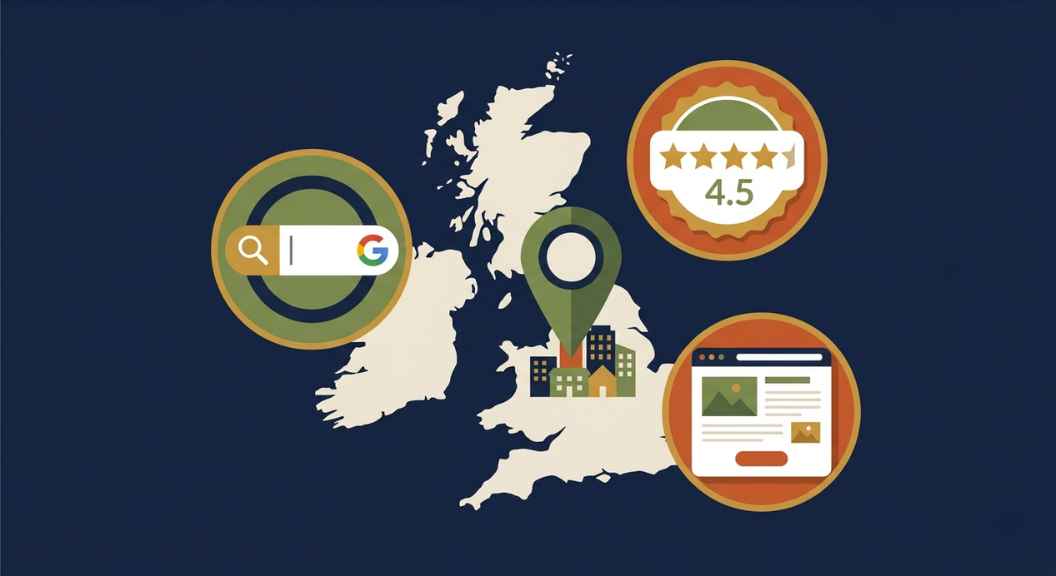
1. Why Most Contractors Struggle to Generate Leads Online
Before looking at solutions, it's worth understanding why so many contractor websites and online profiles fail to bring in meaningful enquiries.
The core issue is this: most contractors approach their online presence as a brochure rather than a lead generation system. A brochure sits on a shelf waiting to be picked up. A lead generation system actively puts you in front of people who are searching for exactly what you offer, at the exact moment they're ready to hire.
The three most common reasons contractors fail to generate leads online are:
They're invisible on Google — their website or Google Business Profile either doesn't rank for relevant local searches or isn't set up correctly
Their website doesn't convert — visitors land on the site but leave without making contact, usually because trust signals are missing or the site is unclear about what they offer
They rely on one channel — typically word of mouth, which is valuable but unpredictable and doesn't scale
Each of these problems has a clear solution. Let's go through them.
2. Local SEO: The Foundation of Contractor Lead Generation
Search engine optimisation for tradesmen and contractors is about one thing: appearing in Google when someone in your area searches for your service. Everything else follows from that.
The searches you want to rank for look like this:
"builder Cardiff"
"electrician Kent"
"home builder near me"
"construction company Austin TX"
"kitchen fitter London"
These are called local intent searches. The person searching has a job that needs doing. They're not researching — they're buying. Appearing in front of them at this moment is the highest-value position in all of digital marketing.
How Google Decides Who Ranks Locally
Google uses three main factors to determine who appears in local search results:
Relevance — Does your business match what the person is searching for? This is influenced by how your website is written, what services you list, and how your Google Business Profile is set up.
Distance — How close is your business to the person searching? You can't move your location, but you can set a service area on your Google Business Profile that tells Google which areas you cover.
Prominence — How well-known and trusted is your business online? This is where Google reviews, backlinks (other websites mentioning you), and the age and authority of your website come in.
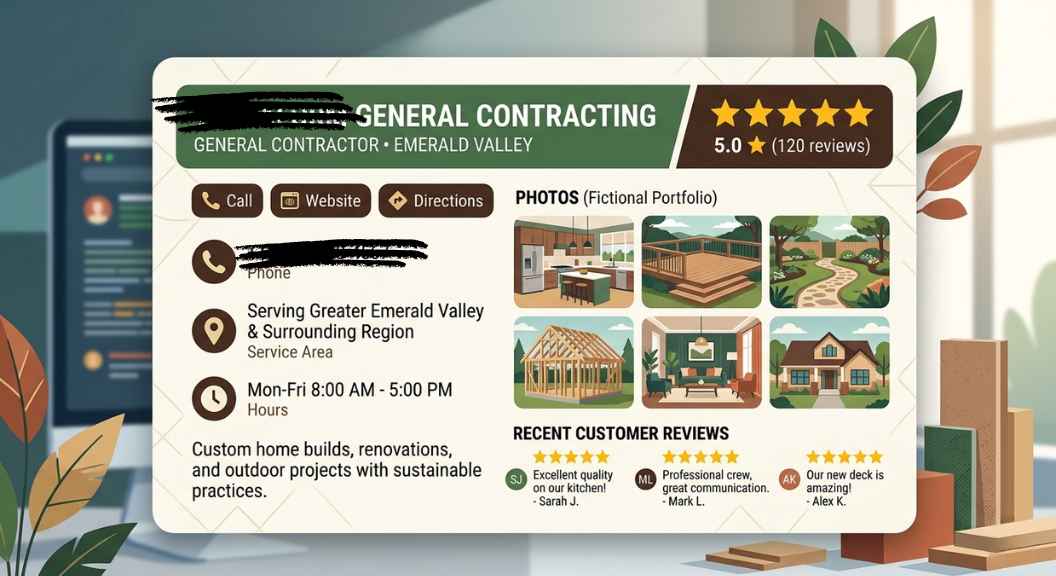
SEO for Tradesmen in Practice
For most tradesmen and contractors, local SEO breaks down into four practical actions:
1. Optimise your Google Business Profile Your Google Business Profile (formerly Google My Business) is the single most important free tool available to local contractors. It powers the local map pack — the three business listings that appear at the top of local search results — and is often the first thing a potential customer sees before they ever reach your website.
A fully optimised Google Business Profile includes:
Your correct business name, address, and phone number
A service area covering every town or postcode you work in
Every relevant service category selected (e.g. builder, roofer, general contractor)
At least 20 recent, genuine Google reviews
Regular posts and updates (at least monthly)
Photos of real completed work, uploaded regularly
Most contractor profiles are half-finished. Filling in every field properly puts you immediately ahead of competitors who haven't.
2. Get your website to mention your location and services clearly Google reads your website to understand what you do. If your website says "quality work at great prices" without ever mentioning that you're a builder based in Kent who does extensions, loft conversions, and new builds — Google doesn't know what to rank you for.
Every key page on your website should clearly mention:
The specific services you offer (use exact terms customers search for)
The towns, cities, and areas you cover
Your business name and contact details
3. Build citations Citations are mentions of your business name, address, and phone number on other websites. Key directories to be listed on include Checkatrade, TrustATrader, Rated People, Bark.com, Yell.com, and the relevant local business directories for your area. Consistent citations across these platforms strengthen your local SEO signals.
4. Earn backlinks from local websites When other local websites — a local newspaper, a community organisation, a supplier — link to your website, Google interprets this as a trust signal. Actively look for opportunities to get your business featured or mentioned on local sites.

3. Google Reviews: The Most Overlooked Lead Generation Tool
If there is one action a contractor can take that has the highest impact for the lowest cost, it is collecting Google reviews. Consistently.
Google reviews affect your business in two ways:
They improve your ranking. Google's algorithm considers the volume and recency of reviews as a ranking factor. A contractor with 60 reviews will generally outrank one with 8, all else being equal. This is especially true in the local map pack.
They convert visitors into enquiries. When someone finds your profile or website, reviews are one of the first things they look at. A tradesman or electrician with 50 five-star reviews from real homeowners in the local area commands immediate trust. One with no reviews leaves doubt.
How to Get Google Reviews as a Tradesman or Electrician
The most effective approach is embarrassingly simple: ask every satisfied customer directly, and give them a link.
After completing a job, send a follow-up message — text or email — that thanks them for the work and includes a direct link to leave a Google review. Most people are happy to do it when they're asked at the right moment and given an easy path.
A simple template:
"Hi [name], it was great working on your [project] — really happy with how it turned out. If you have two minutes, it would mean a lot if you could leave us a Google review. Here's the link: [direct Google review link]. Thanks again."
Send this within 24–48 hours of completing the job, when the experience is still fresh.
Other approaches that work:
Print a small card with your review link (or a QR code) and leave it at every job
Ask at the handover moment in person — then follow up with the link
Add a review request to your standard invoice or receipt
Aim to collect reviews continuously rather than in bursts. Fresh, recent reviews carry more weight than a large number of old ones.
4. Your Website: Converting Visitors Into Enquiries
Ranking on Google gets people to your website. Your website then has one job: turn that visitor into an enquiry.
Most contractor websites fail at this second step, not the first. The reasons are consistent:
Slow loading speed — over half of mobile users will abandon a page that takes more than three seconds to load
No clear service area — visitors don't know if you cover their location
Missing trust signals — no reviews, no testimonials, no photos of real work
Weak or buried contact options — phone number hidden in the footer, contact form with too many fields
Vague headlines — "Quality work, competitive prices" tells no one anything
The Anatomy of a Contractor Website That Actually Converts
Homepage headline: Be specific. "Cardiff's trusted builder for extensions, renovations, and new builds" is far more effective than a generic tagline.
Phone number: Visible at the top of every page. On mobile, it should be a tappable link that calls directly.
Real photos: Before-and-afters, in-progress shots, finished jobs. Real photos of real work build trust that stock images never can.
Google reviews: Display your Google rating prominently. If you have 40 five-star reviews, that number should be visible on your homepage.
Service pages: Each major service should have its own dedicated page. "Kitchen extensions Cardiff," "loft conversions Cardiff," and "house extensions Cardiff" should each be a separate page with specific content. This dramatically improves how Google categorises and ranks your site.
Clear call to action: Every page should end with a simple, low-friction CTA. "Get a free quote" or "Call us today" with a phone number is often more effective than a complex contact form.
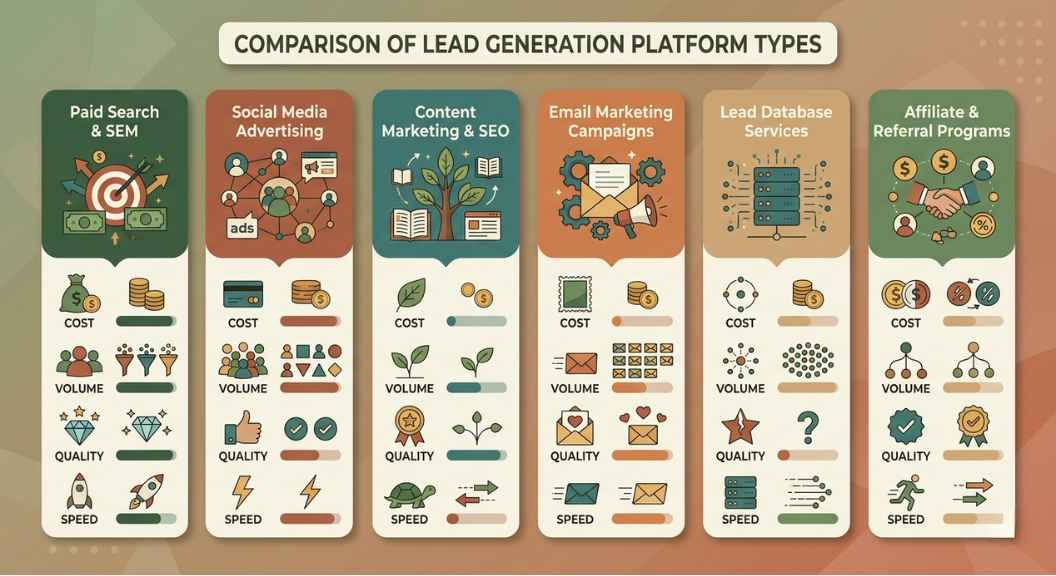
5. Lead Generation Websites for Contractors: What Actually Works
Beyond your own website and Google presence, there are a number of platforms that connect contractors with homeowners looking for tradesmen. Understanding which ones are worth your time and money is important.
Checkatrade (UK) One of the most trusted lead generation platforms for UK tradesmen. The vetting process lends credibility, and homeowners actively use it to find local contractors. Good for electricians, plumbers, builders, and general tradesmen. Works best when combined with genuine, recent reviews on the platform.
Rated People (UK) A quote-based platform where you pay to respond to leads. Quality varies, but it can be a good supplementary source of enquiries, particularly for smaller jobs.
Bark.com (UK) A pay-per-lead model that operates across many trade categories. Lead quality is inconsistent but can work well in areas with lower competition.
HomeAdvisor / Angi (US) The dominant lead generation platform for home improvement contractors in the United States. Particularly relevant for contractors targeting home improvement leads in cities like Austin, TX. Lead quality varies and competition is high, but the volume can be significant. Works best when combined with strong reviews on the platform.
Thumbtack (US) A popular platform for US contractors, particularly for smaller home improvement jobs. Good for building early reviews and getting exposure in competitive local markets.
Important note on lead generation websites: These platforms supplement your own digital presence — they should not replace it. A contractor who relies entirely on paid lead platforms is building on rented ground. Your own website and Google Business Profile, by contrast, are assets that compound over time and cost nothing per lead once established.
6. Paid Advertising for Contractors
Once your organic presence is established, paid advertising can accelerate lead volume.
Google Ads (Pay Per Click) Google Ads puts your business at the very top of search results for chosen keywords. For contractors, this typically means targeting searches like "builder [your town]" or "electrician near me." You pay only when someone clicks.
The advantage is speed — results from day one, rather than the months required for SEO. The disadvantage is cost — competitive trades in large cities can cost £20–£60 per click, and the leads stop the moment you stop paying.
Google Ads works best as a complement to SEO, not a replacement for it.
Local Services Ads (Google Guaranteed) Available in the US and increasingly in the UK, Local Services Ads appear above standard Google Ads and organic results. You pay per lead rather than per click, and the "Google Guaranteed" badge provides significant trust. For home improvement contractors in markets like Austin, TX, Local Services Ads can be highly effective.
Facebook and Instagram Ads Social media advertising for contractors tends to work better for higher-ticket services — extensions, renovations, new builds — where the decision-making process is longer and homeowners are browsing for inspiration. Not the primary channel for tradesmen, but useful for brand awareness and retargeting visitors who've already been to your website.
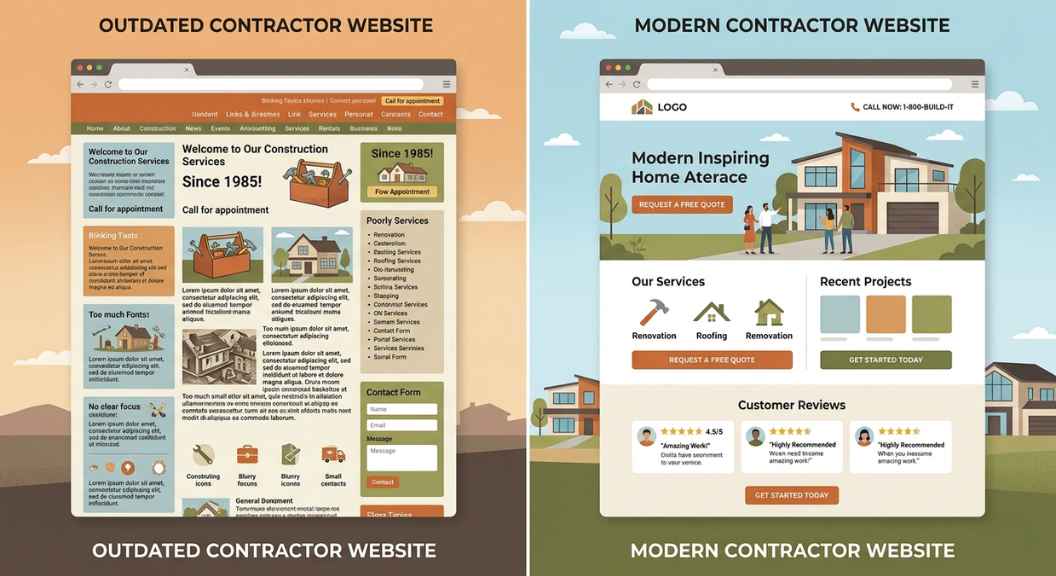
7. Building a Lead Generation System That Compounds
The most successful contractors don't rely on any single channel. They build a system where multiple sources feed into a consistent pipeline of enquiries.
A typical high-performing setup looks like this:
Google Business Profile, fully optimised and regularly updated with posts and photos
40–80+ genuine Google reviews, added to consistently
A well-structured website with dedicated service pages and clear conversion elements
Listings on 2–3 relevant paid directories (Checkatrade, Bark, etc.)
Local SEO maintained through regular content and citation-building
Google Ads running for the highest-value services during peak seasons
Each of these elements reinforces the others. More reviews improve your Google ranking. A better-ranking website brings more visitors. A higher-converting website turns more of those visitors into leads. And as your reputation grows online, so does the quality of the enquiries you receive.
8. Local Lead Generation in Specific Markets
The principles above apply universally, but local markets have their own characteristics worth understanding.
Construction leads in Cardiff and South Wales Cardiff and the broader South Wales market is competitive but not saturated. Contractors who invest in local SEO — particularly around Cardiff-specific keywords and Google Business Profile optimisation — can see strong results. Welsh homeowners use Google and Checkatrade heavily to find local builders, so presence on both platforms is important.
SEO for tradesmen in Kent Kent has a large and geographically spread population, which creates strong demand for local tradesmen. The key challenge is coverage — a Kent tradesman needs to rank for multiple towns (Maidstone, Canterbury, Tunbridge Wells, Folkestone, etc.) rather than a single city. Service area pages on your website, targeting each major town you cover, are particularly effective in this market.
Home improvement leads in Austin, TX The Austin market is one of the fastest-growing in the United States, with significant residential construction and home improvement activity. Google Local Services Ads, Angi, and Thumbtack are the primary platforms for home improvement lead generation in Austin. Given the competitive market, Google reviews and a strong Google Business Profile are critical differentiators.
Conclusion

Lead generation for contractors and tradesmen is not a mystery. It follows a clear logic: get found by the right people, give them reasons to trust you, and make it easy for them to get in touch.
The businesses that consistently win new clients are not necessarily the best tradesmen in their area. They're the ones who have built a visible, trustworthy online presence — and who keep investing in it consistently, even when the diary is full.
If you'd like to understand exactly where your lead generation is falling short and what the highest-impact changes would be for your specific business and area, [we offer a free audit for contractors and tradesmen]. We'll review your website, Google Business Profile, current review profile, and local competition, and give you a clear action plan.
[Book your free contractor lead generation audit →]
FAQs
What is the best lead generation method for contractors? For most contractors, the combination of a fully optimised Google Business Profile, consistent Google review collection, and a well-structured website that ranks for local searches provides the best return. These three channels are low-cost, compound over time, and generate high-intent enquiries from people who are actively looking to hire.
Which are the best lead generation websites for contractors in the UK? The most widely used and trusted platforms for UK contractors are Checkatrade, Rated People, Bark.com, and TrustATrader. Checkatrade is generally considered the most credible in the eyes of homeowners, while Bark.com offers broader volume. Results vary significantly by trade, area, and how well your profile is set up on each platform.
How do I get construction leads in Cardiff? Focus on three areas: optimise your Google Business Profile with Cardiff listed as your primary service area, build a website with specific pages targeting Cardiff-based services (e.g. "extensions Cardiff," "renovations Cardiff"), and collect Google reviews consistently. Listing on Checkatrade and Bark.com with good reviews will also generate supplementary leads in the Cardiff market.
How does SEO help tradesmen in Kent get more leads? SEO helps tradesmen in Kent appear in Google when local homeowners search for their services. Because Kent covers a wide geographic area, the most effective approach is creating individual service-area pages on your website for each major town you cover, combined with a Google Business Profile with a broad service area and strong local reviews.
How do I get more Google reviews as an electrician? Ask every satisfied customer directly after completing a job, and send them a direct link to your Google review page. A follow-up text or email within 24–48 hours of job completion is the most effective method. You can also leave a printed card with a QR code at each job. Consistent review collection — rather than occasional bursts — is what builds ranking and trust over time.
How do home improvement contractors in Austin TX get more leads? For Austin-based contractors, Google Local Services Ads, Angi, and Thumbtack are the most active platforms for home improvement lead generation. Combine these with a locally optimised website and Google Business Profile — including Austin-specific keywords and a strong portfolio of Google reviews — to build a presence that generates enquiries from multiple sources.
Why is my contractor website not getting leads even though it looks good? A well-designed website that doesn't generate leads is almost always missing one or more of the following: local SEO (so Google can find and rank it), clear trust signals like reviews and real project photos, a visible phone number on every page, and specific service and location information. Design quality has much less impact on lead generation than these structural and content factors.