
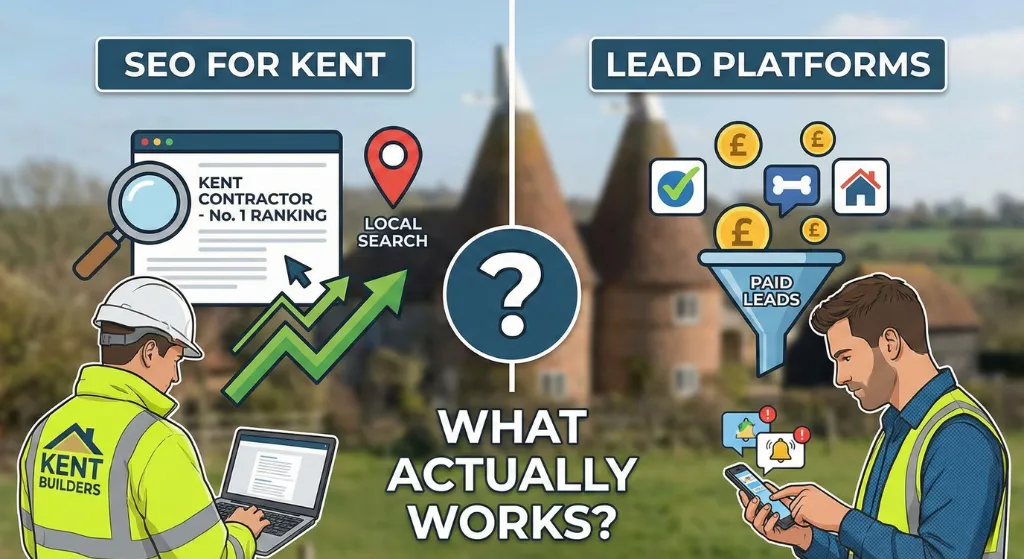
SEO vs Lead Platforms for Kent Contractors: What Actually Works?
Contractors across Kent have more marketing options than ever.
Between Google search, Google Maps, trade directories, and pay-per-lead platforms, there’s no shortage of ways to generate enquiries. The challenge is not finding options — it’s understanding which ones actually produce consistent, profitable work over time.
This article looks objectively at SEO versus lead platforms for Kent contractors. Not to criticise either approach, but to explain how they work, what they cost, and where each one fits depending on your goals.
If you’re a builder, roofer, electrician, plumber, or general tradesperson operating in areas like Tonbridge, Edenbridge, Hythe, New Romney, or West Malling, this comparison will help you make better long-term decisions about how you attract work.
The Real Question Contractors Should Be Asking
Most marketing discussions focus on volume:
How many leads?
How quickly?
How cheaply?
But experienced contractors tend to ask different questions:
Who controls the demand?
How predictable is it?
What happens if I stop paying?
This is where the difference between SEO and lead platforms becomes clear.
Understanding Lead Platforms in Simple Terms
Lead platforms are designed to aggregate demand.
Homeowners submit a job request, which is then shared with multiple contractors. Each contractor pays for access, either per lead or via subscription.
For many Kent contractors, platforms such as Bark or Checkatrade have been a starting point — especially when launching a business or filling gaps in the diary.
What Lead Platforms Do Well
Fast access to demand
Simple onboarding
No technical setup
Predictable short-term flow
In towns like Hythe or New Romney, where local visibility may be limited early on, this can help establish initial traction.
The Limitations of Platform-Based Leads
Over time, contractors often notice trade-offs:
Multiple contractors contacting the same homeowner
Pressure to respond instantly
Increased competition on price
Rising cost per booked job
None of these are inherently “bad” — they’re simply characteristics of a shared marketplace.
The key limitation is control. Demand belongs to the platform, not the contractor.
What SEO Actually Means for Kent Contractors
SEO (Search Engine Optimisation) is fundamentally different.
Instead of sharing demand, SEO focuses on earning visibility when someone searches directly for a service in their area.
Examples include:
“Builder in Tonbridge”
“Electrician near West Malling”
“Plumber Edenbridge emergency”
These searches show intent — the user is actively looking for someone to hire.
SEO Is About Ownership, Not Just Traffic
When SEO works well:
Your website attracts local visitors
Google Maps displays your business
Reviews support credibility
Calls come directly to you
There is no bidding against other contractors for the same enquiry.
This creates what many contractors describe as owned demand — visibility you don’t lose the moment spending stops.
Cost Over Time: A Practical Comparison
Lead Platforms
Ongoing per-lead or monthly costs
Costs scale with volume
Spend stops = leads stop
SEO
Higher upfront investment
Slower initial results
Costs reduce over time
Visibility compounds
In Kent towns like Edenbridge or West Malling, where local reputation matters, SEO often becomes more efficient the longer it runs.
Lead Quality and Intent
Lead quality is not just about job size — it’s about readiness.
Platform users may still be:
Comparing prices
Unsure of scope
Gathering quotes
SEO users are often:
Further along in decision-making
Looking for trusted local businesses
Ready to book
This difference directly affects close rates.
High-Converting Websites: The Common Foundation
Whether leads come from platforms or Google, conversion happens on your side.
High-performing contractor websites share:
Clear service descriptions
Local references
Strong trust signals
Simple contact paths
Fast loading on mobile
Without this foundation, both SEO and paid leads underperform.
Why SEO and Google Maps Work Together
For contractors, SEO rarely works alone.
Google Maps visibility often drives:
Calls
Direction requests
Immediate contact
Strong Maps rankings are supported by:
Accurate business details
Reviews
Proximity
Website relevance
In Tonbridge or Hythe, this local proximity advantage is significant.
Why SEO Compounds Over Time
SEO builds layers:
More content → more relevance
More clicks → stronger signals
More reviews → higher trust
Each improvement reinforces the next.
This is why contractors often describe SEO as “slow at first, then steady”.
Where Ads and Remarketing Fit In
Paid ads don’t compete with SEO — they reinforce it.
Smart contractors use ads to:
Support new service launches
Cover seasonal demand
Retarget website visitors
When layered on top of SEO, ads perform better and cost less per conversion.
Missed-Call Text Back: A Simple Safety Net
Regardless of lead source, missed calls cost jobs.
Automated missed-call text responses:
Acknowledge the enquiry
Buy time to respond
Increase booking rates
This small system often recovers leads that would otherwise be lost.
A Balanced View: When Each Approach Makes Sense
Lead Platforms Make Sense When
You need immediate work
You’re new to an area
You want predictable short-term volume
SEO Makes Sense When
You want long-term control
You prefer direct enquiries
You’re building a local brand
Many Kent contractors ultimately use both, but shift emphasis toward SEO over time.
Real-World Kent Examples
A builder in West Malling using SEO to dominate extensions and renovations
A roofer in Tonbridge ranking on Maps for emergency repairs
A plumber in Edenbridge receiving repeat local enquiries without ongoing lead fees
These outcomes come from visibility, not volume alone.
What “Working” Actually Means
Marketing works when:
Enquiries are relevant
Costs stay predictable
Control increases over time
SEO doesn’t replace every tactic — it stabilises your business.
A Logical Next Step
If you’re deciding between continuing with lead platforms, adding SEO, or adjusting your mix, the most useful step is clarity.
Review where your enquiries actually come from, how much each booked job costs, and which channels you control.
From there, the right strategy usually becomes obvious.
That insight alone often changes how contractors allocate their time and budget.