
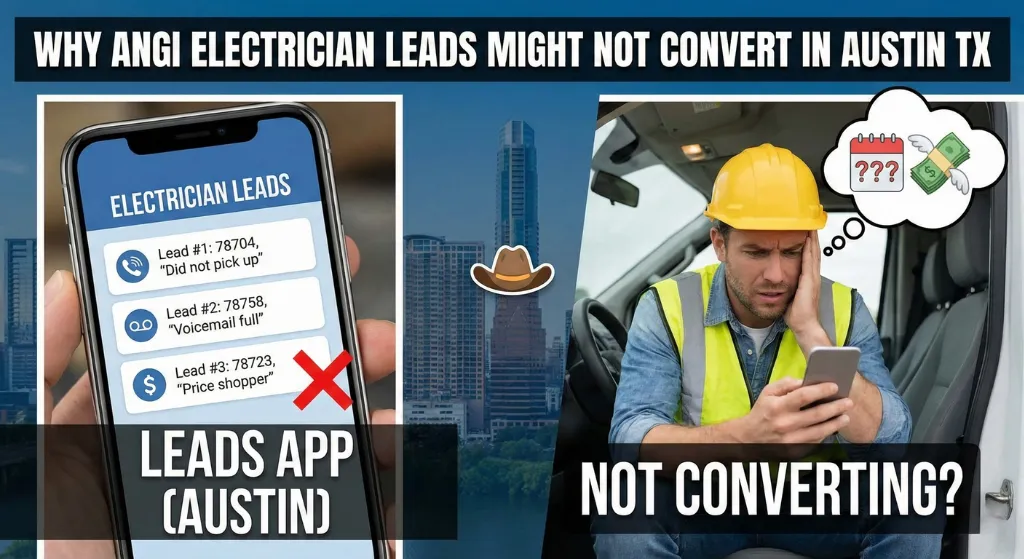
Why Angi Electrician Leads Might Not Convert in Austin TX
Austin is one of the fastest-growing cities in the United States, and demand for electrical work has never been higher. Remodels, extensions, EV chargers, panel upgrades, rentals, and emergency callouts are happening across the city every day.
There is no shortage of work.
Yet many electricians across East Austin, South Congress, Zilker, Mueller, Round Rock, Cedar Park, Pflugerville, and Leander notice a similar pattern:
They receive enquiries — but fewer of those enquiries turn into booked jobs than they expect.
This article explores why that can happen in a market like Austin, and how local electricians are adjusting their approach as competition increases. It’s not about blaming any one lead source. It’s about understanding how crowded markets change conversion behaviour.
A Crowded Market Changes How Leads Convert
Lead directories and job platforms are designed to surface demand quickly. They bring homeowners and electricians together efficiently, and in many markets this works perfectly well.
Austin, however, behaves a little differently.
The city’s growth has created a situation where high demand and high supply exist at the same time. That combination changes outcomes — even when leads are genuine and homeowners are serious.
In practical terms, electricians are often competing against many other qualified professionals for the same enquiry.
Austin Is an Unusually Competitive Electrical Market
Austin has several factors working together:
Rapid population growth
Constant residential development
A dense concentration of licensed electricians
Strong rental and commercial demand
In neighbourhoods like Mueller, Zilker, and South Congress, it’s common for homeowners to receive multiple responses almost immediately after submitting a request.
When that happens, results are shaped less by skill alone and more by timing, availability, and context.
This isn’t a flaw in the system — it’s a by-product of a fast, competitive market.
Shared Enquiries Create Natural Response Pressure
In dense cities, speed matters more than ever.
A typical scenario looks like this:
A homeowner submits a request
Several electricians respond within minutes
The homeowner makes a quick decision
Often, that decision happens before there’s time to properly explain experience, process, or specialisation.
The more electricians competing for the same enquiry, the narrower the window to influence the outcome.
Price and Availability Become the Default Filters
When multiple electricians are considered at once, conversations naturally drift toward:
Who can come soonest
Who responds first
Who sounds simplest to book
This can make it harder to demonstrate value — particularly for electricians doing higher-end residential work in areas like Mueller or Zilker, where homeowners care about professionalism, clarity, and trust.
Again, this isn’t about “bad leads”. It’s about how comparison environments shape decisions.
The Real Cost Is Often Time, Not Just Money
Most electricians don’t struggle with lead volume. They struggle with what it takes to convert those leads.
Each shared enquiry usually requires:
Immediate response
Back-and-forth messages
Follow-up that may not progress
During busy periods, this time investment becomes significant — especially for solo operators or small teams.
Close Rates Naturally Drop in High-Density Areas
In areas like East Austin or South Congress, close rates are often lower simply because:
Homeowners speak to several electricians
Decisions are made quickly
The opportunity to influence is short
As competition increases, the cost per booked job rises — even if the cost per lead stays the same.
This is one of the first signals electricians notice as markets mature.
Control Becomes the Missing Piece
Shared lead sources are effective for filling gaps, but they offer limited control over:
When enquiries arrive
How competitive each enquiry is
Whether the homeowner is comparing options
As electricians aim for more predictable schedules, this lack of control becomes more noticeable.
How Many Austin Electricians Adapt
Most electricians don’t abandon directories altogether.
Instead, they rebalance.
The shift isn’t about replacing one platform with another — it’s about adding more direct, intent-driven enquiries into the mix.
Over time, many electricians prioritise:
Local intent
Direct calls
Fewer competitors per enquiry
Exclusive Enquiries Change the Dynamic
Exclusive enquiries differ in one important way:
only one electrician receives the call.
These typically come from:
Google searches
Google Maps results
Direct website visits
The homeowner isn’t comparing five quotes at once. They’re calling you.
In a city like Austin — where urgency is common for rentals and emergencies — this changes conversion rates significantly.
Where High-Quality Electrician Jobs Usually Come From
High-quality jobs tend to come from active intent, not browsing.
Examples include searches like:
“electrician near me”
“residential electrician Austin”
“commercial electrician Austin TX”
These searches signal readiness. The homeowner isn’t exploring options — they’re selecting one.
Residential Demand Across Austin
In areas like Mueller and Zilker, electricians regularly see:
Remodel-driven upgrades
Panel replacements
Lighting and circuit work
EV charger installations
Homeowners searching locally often book quickly once they find a trustworthy option.
Rental and Emergency Work
Areas such as Round Rock, Pflugerville, and Cedar Park generate consistent rental-related demand:
Faults
Compliance checks
Fast-turnaround jobs
In these cases, proximity and responsiveness matter more than comparison.
Commercial Work Behaves Differently
Austin’s commercial growth creates demand for:
Small business fit-outs
Ongoing maintenance
Long-term electrical support
These enquiries are rarely sourced through shared requests. They tend to come from direct searches, referrals, and reputation.
Why Direct Search Aligns Better With Austin Behaviour
Google-based enquiries work well in Austin because they match how people actually look for help.
Instead of submitting a form and waiting, homeowners:
Search
Scan results
Call the electrician they trust most
This naturally filters enquiries:
Customers willing to pay for quality call directly
Emergency jobs go to the closest available electrician
Commercial clients prioritise credibility
Improving Conversion Is About Reducing Friction
Getting better results isn’t about chasing every lead source.
It’s about making it easier for the right homeowner to reach you at the right moment.
Electricians who improve conversion usually focus on:
Being visible where intent is highest
Making it easy to call or enquire
Responding quickly when interest is fresh
In competitive cities like Austin, this consistently outperforms volume-based approaches.
Local Context Matters More Than Ever
Austin isn’t one uniform market.
Demand varies by area:
East Austin: remodels and older homes
South Congress: residential and small commercial
Zilker: higher-end residential expectations
Round Rock & Leander: family homes and repeat work
Cedar Park & Pflugerville: rentals and fast-turnaround jobs
Electricians who align visibility with these patterns convert more reliably.
A Practical Next Step
If your current lead mix brings enquiries but conversions feel lower than they should, that doesn’t mean anything is “wrong”.
It usually means the market has evolved.
A useful starting point is simply to review:
Where your best jobs actually come from
How many competitors you face per enquiry
How quickly you can respond when someone is ready to book
From there, most electricians naturally move toward fewer, higher-intent enquiries rather than chasing volume.
That approach fits Austin — and it scales far more comfortably over time.
If you’d like this handled for you end-to-end, you can apply here.